Tales RPG: AI Text Adventure
- 4.3
- Rating
- 10.00K
- Installs
- Free
- Price

 Analysis by App-foxy
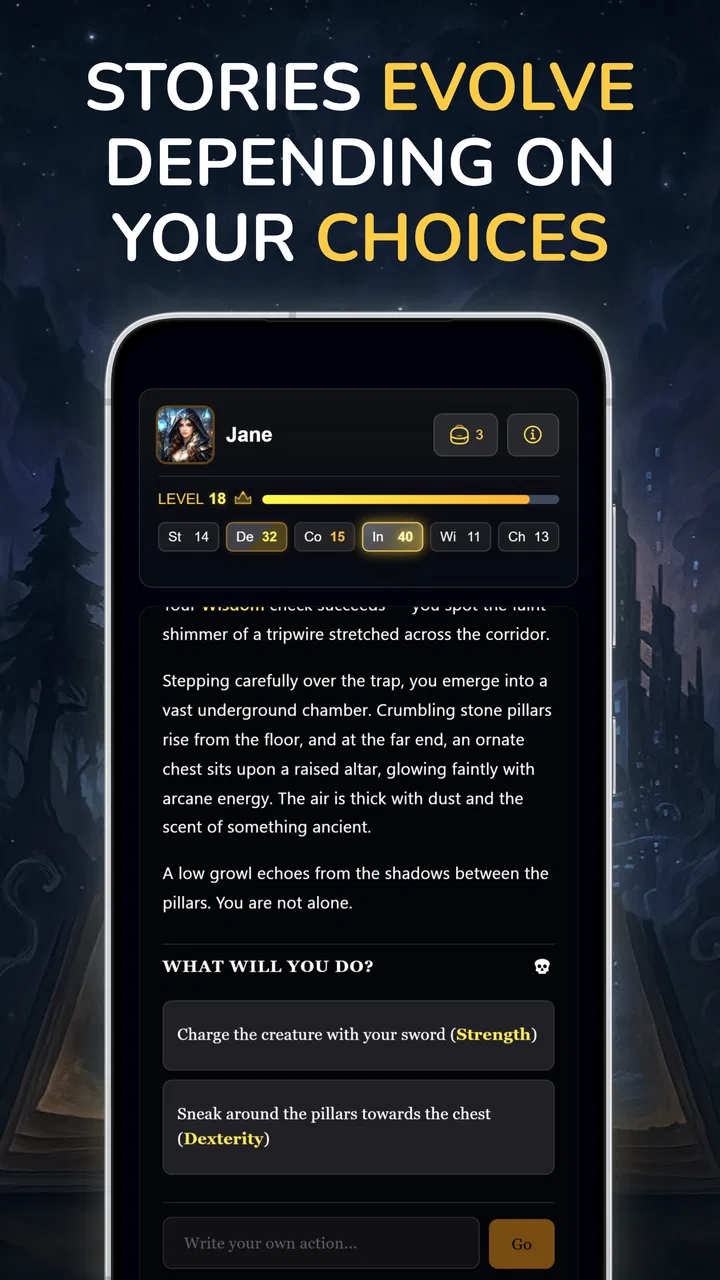
I approached Tales RPG: AI Text Adventure less like a conventional game to finish and more like a story box that different people in a household could open at different times. Its central idea is simple: you make choices in a text-based adventure, and an AI-driven narrative reacts to the direction you take. That makes it appealing when you want imagination rather than reflexes, but it also means the quality of the experience depends heavily on how clearly you play and what kind of story you expect.
Developed by DWStudio, this free adventure game is aimed at mature players and is available for devices running Android 6.0 or later. It has a 4.3 average from over eight hundred ratings, along with more than ten thousand installs. Those numbers suggest a modest but active audience rather than a huge mainstream hit. After spending time with its premise and considering how it fits into everyday use, I see it as a particularly interesting choice for solo players who enjoy making decisions, testing unusual ideas, and accepting that an AI storyteller may sometimes surprise them in ways a tightly scripted game would not.
How Tales RPG fits into a shared household
The most convincing shared-device scenario is not a family sitting together for a brightly colored multiplayer session. This is better suited to one person starting a story, pausing when life gets in the way, and another household member using the same device later for a separate adventure or a different style of play. A quiet evening, a long wait, or a commute can all work well because the game does not ask for fast reactions or constant attention to a busy screen.
You May Also Like

 AccuWeather: Weather Radar
AccuWeather Review: A Quick, Clear Forecast for Everyday Decisions
For everyday plans, the best forecast is the one you can understand quickly. AccuWeather makes rain timing, radar, and local conditions easy to act on, with a few trade-offs.

 Hill Climb Racing
Why Hill Climb Racing Still Turns Crashes Into One More Run
A tiny car, a bumpy hill and one more upgrade: Hill Climb Racing keeps resurfacing because its simple chaos makes every near-miss feel personal.

 AliExpress - Shopping App
AliExpress Makes Global Shopping Feel Personal, but Shoppers Bear the Risk
AliExpress turns a global marketplace into a pocket-sized discovery engine. Its reach is useful, its shopping loop compelling, and its trade-offs easy to miss.

 Lords Mobile: Kingdom Wars
Lords Mobile Is a Kingdom-Building Routine, Not a Quick Match
A case-by-case verdict on the building, battles, device demands, and social commitments that make Lords Mobile rewarding for some players and exhausting for others.

 PDF Scanner app - TapScanner
TapScanner Makes Paperwork Easier to Capture, Check, and Share
TapScanner makes scanning with a phone feel less like a rescue operation and more like a dependable step in getting work done. Its capture tools are useful, though not flawless.

 Block Blast!
 Shows How Much a Puzzle Game Can Leave Out
A quiet grid game shows why puzzle players increasingly value instant clarity, repeatable skill and low-pressure play—and where the genre still needs to catch up.
More From Our News Desk
View All News


I would be comfortable recommending the concept for a household that already understands the difference between sharing a device and sharing a game session. Text adventures are personal by nature. One player may want a serious heroic journey, while another prefers absurd decisions and deliberately chaotic outcomes. Mixing those expectations in one ongoing tale can make the experience confusing, especially if someone continues the story without knowing what the previous player intended.
My practical advice is to treat each story as belonging to one player unless everyone has explicitly agreed to collaborate. Before handing over the phone, say whether the next person should continue the current adventure or begin their own. That small bit of coordination matters more here than it would in a typical arcade game, because a single unexpected choice can change the tone or direction of a narrative.
The game’s text-first design also makes it less disruptive than action-heavy alternatives. There is no need to find a large uninterrupted space or keep the volume on. That is useful in a shared home where one person is watching television or another is sleeping. At the same time, the written format requires attention. It is not something I would recommend playing while carrying on a conversation, cooking, or supervising a young child. Missing a paragraph can make a later decision feel arbitrary.
Separate expectations before starting
One of the less obvious strengths of an AI-led adventure is that it rewards players who decide what they want before they begin. If I start with only the thought that I want “a fantasy story,” I may get a less satisfying session than if I first choose a role, a mood, and a personal rule. For example, I might play a cautious traveler who avoids unnecessary violence, or a reckless explorer who always chooses the most dangerous option. These boundaries give the story a shape and make the choices feel more meaningful.
This is especially useful when several people use the same phone. Each person can establish a different identity for their own session instead of assuming the game will automatically understand who is playing. I would keep the distinction clear in conversation and avoid treating another person’s narrative as a communal save unless that is the intended arrangement.
There is also a trade-off here. A traditional role-playing game usually gives me a visible character sheet, a defined setting, and a known set of systems. An AI text adventure can feel more open, but that openness may be less predictable. If I want exact rules, carefully balanced combat, or a story that always follows a writer’s intended arc, a conventional RPG will probably be the better choice. If I enjoy improvisation and can accept occasional unevenness, this format has more room for personal experimentation.
For the best first session, I would avoid trying to test every possible idea at once. Start with a clear character and one immediate objective. Make choices that fit that identity, then see how the narrative responds. Once I understand the rhythm, I can deliberately challenge the story with unusual actions. That workflow gives me a useful baseline before I decide whether the game’s flexibility is genuinely entertaining or simply too loose for my taste.
Coordinating play without losing the story
Shared use creates a question that store summaries rarely answer: what happens socially when more than one person wants to play? Since this is a text adventure rather than a conventional competitive game, the main issue is not taking turns quickly. It is preserving context. I would recommend agreeing on a simple handoff routine: finish at a natural stopping point, tell the next player what kind of decision is pending, and avoid making a major choice on someone else’s behalf.
That approach works well for couples, roommates, or friends sharing a tablet. One person might create the setting and the other might continue it, but the arrangement should be intentional. Otherwise, the story can become a confusing blend of personalities. The same advice applies if someone leaves the game open and another person picks up the device casually. A short conversation can prevent an accidental change to a carefully developed adventure.
I also think the game is more enjoyable when players discuss the interesting decisions afterward rather than constantly reading over one another’s shoulders. The appeal is partly in wondering what another person would do. If every choice is debated before it is entered, the experience can lose the personal quality that makes interactive fiction work. A household can coordinate access while still leaving room for individual judgment.
For a shared device, I would keep notifications and interruptions in mind as well. Not because the game requires a special setup, but because text-based storytelling is vulnerable to distraction. If a message pulls me away halfway through an important scene, I may return without remembering the details that made the next choice meaningful. A short, focused session is often better than trying to squeeze the game into every spare second.
Age, trust, and the mature rating
The mature 17+ rating should be treated as a real household boundary, not as a minor label. An AI-driven narrative can move in unexpected directions, and the open-ended nature of the format makes it unsuitable to hand to a child simply because the interface looks like plain text. Parents and guardians should make the decision based on the player’s age, maturity, and ability to handle adult themes, rather than assuming that a non-graphic presentation is automatically appropriate.
This matters even more when the game is installed on a shared phone. A younger household member may see the title, open the app, or continue a session without understanding the intended audience. I would keep use limited to the mature player and make the age expectation clear to everyone who uses the device. That is a matter of trust and communication, not a feature I would assume the game handles for me.
Adults should also remember that an AI storyteller is not the same as a human moderator or a tightly controlled book. I would approach unusual or uncomfortable turns with judgment, stop a session if its direction no longer feels suitable, and avoid treating every generated development as an instruction to continue. The player remains responsible for deciding what belongs in their leisure time.
For a household with children looking for a shared game, I would choose something designed and rated for younger players instead. Tales RPG is a better fit for adults who can discuss boundaries openly and who understand that mature content expectations change the way the game should be used. That limitation is important enough that it outweighs the convenience of its free entry point for many families.
What the free model means in practice
The game can be downloaded for free, but it includes optional purchases ranging from $1.49 to $34.99 per item. I would therefore set a clear household rule before letting someone else use the device: free installation does not necessarily mean every part of the experience is cost-free. On a shared phone, that conversation is especially important when multiple people can access the same store account or payment method.
I would not assume that another player understands the difference between an in-game prompt and a purchase screen. Adults sharing a device should agree on whether purchases are allowed, who approves them, and whether the game is being used only within its free portion. This is a simple coordination step, but it prevents a story session from turning into an unexpected billing discussion.
The purchase range also changes who should try the game. If I am only curious about AI storytelling, the free starting point makes it easy to explore the concept without committing immediately. If I already know I dislike optional spending in narrative games, I should approach the app cautiously and decide my limit before playing. The important point is to judge it as a free download with in-app purchase options, not as a completely purchase-free experience.
Its current version is 98, which tells me the app has an established version line rather than being presented as an untouched first experiment. I would still keep expectations realistic: a version number alone does not turn an AI-generated story into a polished, fixed campaign. The appeal remains the interaction between player choices and generated narrative, not the promise of a perfectly predictable role-playing system.
Where it beats ordinary adventure games
Compared with a standard mobile adventure game, this one is strongest when I want to author my own direction. A conventional title may give me beautiful environments, voiced characters, puzzles, and carefully staged missions. Tales RPG instead asks me to imagine the scene through words and decide what my character does next. That makes it lighter on hardware and more flexible in tone, but also more dependent on my willingness to read and participate.
It can be a good alternative to a choose-your-own-adventure book when I want more immediate interaction. A printed story offers a fixed set of branches, while an AI-driven format suggests a broader conversational space. The trade-off is consistency. A human-written book has deliberate pacing and editing; a generated adventure may feel more spontaneous but less controlled. I would choose the app for experimentation and replayable decision-making, not for a guaranteed literary experience.
It also differs from online multiplayer RPGs. There is no need to coordinate a party’s schedule or compete with players who have more time. That makes it attractive for someone who wants role-playing without social pressure. On the other hand, it does not replace the camaraderie, shared tactics, or persistent world of a multiplayer game. A person seeking group progression should look elsewhere.
The most useful comparison is perhaps with tabletop role-playing. Like a tabletop session, the fun comes from imagining a character and responding creatively. Unlike a human game master, an AI system does not know my preferences through a personal relationship, and it may not always interpret a clever action exactly as I intended. I can enjoy Tales RPG as a private improvisation tool, but I would not expect it to reproduce the nuance of a trusted group around a table.
Small techniques that improve a session
I found that specificity is more valuable than length when making decisions. Instead of entering a vague command such as “I explore,” I would describe the immediate intention and the reason behind it: I inspect the damaged doorway because I suspect someone used it recently. This gives the narrative a clearer direction without turning every response into an essay. It is one of the easiest ways to make the AI-led structure feel more responsive.
A second useful technique is to maintain a personal rule for risk. For example, I might allow my character to retreat after one serious warning, or I might refuse to use violence unless there is no alternative. This creates continuity across scenes and prevents the adventure from becoming a random sequence of disconnected impulses. In a shared household, telling another player that rule before they continue also helps preserve the character’s identity.
Third, I would stop at a natural decision rather than ending immediately after a dramatic reveal. The next player, or my future self, will have a much easier time returning when the situation is clear. This is particularly valuable on a shared device because it reduces the chance that someone will make a choice simply to discover what is happening.
Finally, I would treat surprising results as material to work with rather than proof that the game has failed. Sometimes an unexpected turn can become the most memorable part of the session if I reinterpret it creatively. But there is a limit: if the narrative repeatedly loses track of the character or mood, I would stop investing in that story and begin again. The format rewards flexibility, not blind patience.
Who should install it and who should skip it
I would recommend this adventure game to adults who enjoy reading, improvising, and making choices without needing a visible map or a large collection of mechanics. It is especially suitable for someone who wants a private role-playing experience during short breaks, or for a household where mature players share a device but can respect each other’s story boundaries.
I would also suggest it to players who have grown tired of mobile games built around rapid taps, repetitive levels, or constant visual effects. The slower pace is a strength if I want my imagination to do some of the work. It can be a pleasant change from games that demand immediate reactions.
I would skip it if I need a fully authored plot, reliable continuity, or a clear progression system that explains exactly how success is measured. I would also avoid it for young children, for households that cannot agree on purchase permissions, and for anyone who dislikes reading on a phone. A traditional adventure game is the better option when presentation, polish, and predictable storytelling matter more than freedom.
The rating of 4.3 is encouraging, but I would not use it as a guarantee that every player will have the same experience. AI-driven storytelling is unusually personal: one person’s clever, surprising turn can be another person’s frustrating inconsistency. The number of reviews, over eighty, makes the score useful as a general signal, but my own expectations would still matter more than the average.
My household verdict
Tales RPG works best when I treat it as a flexible storytelling companion rather than a complete replacement for a traditional RPG. Its free entry, low-pressure text format, and AI-led responses make it easy to try, while the mature rating and optional purchases require adult awareness on a shared device. Those boundaries are not minor details; they determine whether the game feels like a thoughtful leisure activity or an awkward fit for the household.
For a mature player using a personal phone, I see a lot of room for inventive sessions. For several adults sharing one device, I would establish separate stories, agree on purchase rules, and hand over the game only at clear stopping points. That small amount of coordination protects the experience without making it feel formal.
My final recommendation is positive but specific: choose it if you want to guide an unfolding text adventure and are happy to meet the AI halfway with clear, imaginative decisions. Do not choose it expecting the fixed balance, polished presentation, or dependable narrative structure of a major role-playing release. Its real appeal is the freedom to shape a story, while its real cost is accepting that freedom’s unpredictability.
With DWStudio behind it, support for Android 6.0 and newer, and a mature audience in mind, the game occupies a distinctive space in mobile adventure gaming. I would give it a try during a quiet evening, set expectations before sharing it, and judge the first few sessions by how much I enjoy creating possibilities—not by whether every generated turn behaves like a scripted quest.
FAQs for Tales RPG: AI Text Adventure
01What is Tales RPG: AI Text Adventure?
Tales RPG: AI Text Adventure is an interactive role-playing game built around AI-generated storytelling. Instead of following a fixed set of scenes, you create a character, choose a setting, and respond to situations using your own decisions. The AI acts as the narrator and adapts the story, characters, quests, and consequences according to your choices, making each adventure feel more personal and unpredictable.
02How does gameplay work in Tales RPG: AI Text Adventure?
Gameplay is mainly based on reading narrated events and entering decisions or actions in text form. You may explore locations, speak with characters, solve problems, fight enemies, or attempt creative solutions. The AI interprets your input and continues the adventure. Because the experience is open-ended, there may not always be one correct answer, and the quality of the story can depend on how clearly and creatively you describe your actions.
03Does Tales RPG: AI Text Adventure require an internet connection?
An internet connection is generally important for Tales RPG: AI Text Adventure because the application relies on AI processing to generate story responses. Offline play may be limited or unavailable, depending on the version and the developer’s current service configuration. A stable connection is recommended, especially during longer sessions, since interruptions can prevent actions from being processed or delay the continuation of your adventure.
04Is Tales RPG: AI Text Adventure free to download and play?
The app may be available to download at no initial cost, but users should check the current store listing for details about advertisements, premium features, subscriptions, credits, or limits on AI interactions. AI-powered games can place restrictions on how many responses are available without payment. Before starting a long campaign, review the in-app purchase information so you understand any recurring charges or optional upgrades.
05Is Tales RPG: AI Text Adventure suitable for children?
Suitability depends on the game’s current age rating, content settings, and the type of prompts used during play. Since the AI can generate varied situations and dialogue, stories may sometimes include violence, frightening themes, romance, or mature topics. Parents should review the official rating and privacy information, supervise younger players, and avoid allowing children to share personal information through free-form text input.
Pros
- AI creates unique story paths from your choices.
- Text-based format works well on low-end devices.
- Flexible gameplay supports creative
- unexpected decisions.
- Easy to start without learning complex controls.
- Good choice for fans of interactive fiction and role-playing.
Cons
- Story quality can vary between different AI-generated scenes.
- Some responses may feel repetitive during longer adventures.
- Requires an internet connection for AI-generated content.
- Limited visuals may not appeal to players wanting rich graphics.
- Improper or confusing AI responses can occasionally disrupt immersion.

Tales RPG: AI Text Adventure
Gallery